Cell Renewal: Why Scrubbing Doesn't Help the Skin Renew Itself
It’s often said that the skin “renews itself every 28 days,” and that as we age, all we need to do is help it along by exfoliating to restore a smooth texture. Both ideas are misleading. The rate of renewal varies by area and by age, and it slows down much later than people think. Above all, rough skin isn’t always caused by a slow renewal process—it’s often due to a surface that’s too dry to properly shed its dead cells. And that can’t be fixed with exfoliation.
What “renewal” Really Means
The epidermis functions like a conveyor belt. Deep down, cells divide. They slowly move upward toward the surface, transforming as they go—losing their nuclei, flattening out, and eventually forming the stratum corneum: a thin layer of cells bound together by a lipid cement. Once they reach the very top, they shed one by one, unnoticed. This is called desquamation.
"Renewal" therefore refers to two things: the rate at which cells are produced deep within the skin, and the way they leave the surface. We hear a lot about the first one. It's often the second one that's visible.

The Routine — VIBRE PARIS
With age, a real slowdown—but one that comes late
In 1983, Gary Grove and Albert Kligman measured this rate in volunteers by tracking the disappearance of a fluorescent dye applied to the skin. In younger participants, the stratum corneum of the forearm was completely replaced in just under three weeks; in those over 60, it took nearly a month. Since the number of cell layers remained the same, the authors concluded that it is the production deep within the skin that slows down.
The most interesting detail lies elsewhere: according to their analysis, this rate remains fairly stable during early adulthood, and it is mainly after age 50 that it drops significantly. The 28-day figure is therefore neither a rule nor a biological clock that goes haywire at age 30. If your skin texture has changed by age 35, that’s rarely the cause.
The skin isn't lacking in vitality. It often lacks the water it needs to shed what's worn out.
The real problem: the surface is too dry to break away
For a long time, the stratum corneum was thought to be an inert layer. We now know that it is the site of intense enzymatic activity. The cells in this layer are held together by small protein bonds, which enzymes must break down to free the surface. However, these enzymes need water to function.
The work of Anthony Rawlings and Clive Harding has clearly described this: when the stratum corneum lacks moisture—due to cold, heating, or a cleanser that’s too harsh—these bonds are no longer properly broken down. The cells remain stuck together in small clumps, and the surface becomes rough, sometimes visibly flaky. This is what people mistakenly interpret as an excess of “dead skin” that needs to be removed.
Why Scrubbing Isn't the Answer
The instinct is understandable: if something builds up, you remove it. But vigorous exfoliation removes cells without replenishing what’s missing—water and lipids—and can damage the protective barrier. The American Academy of Dermatology reminds us that exfoliation isn’t suitable for all skin types, that it should be gentle, and that the more intense the exfoliation, the less frequently it should be done—and that overdoing it can leave the skin red and irritated. If your skin already feels tight or is peeling, our article on the signs of over-exfoliated skin can help you assess your situation.
The relevant question, then, is not “How can we accelerate?” but “How can we create the conditions for our own renewal?”
What Really Helps the Skin Renew Itself
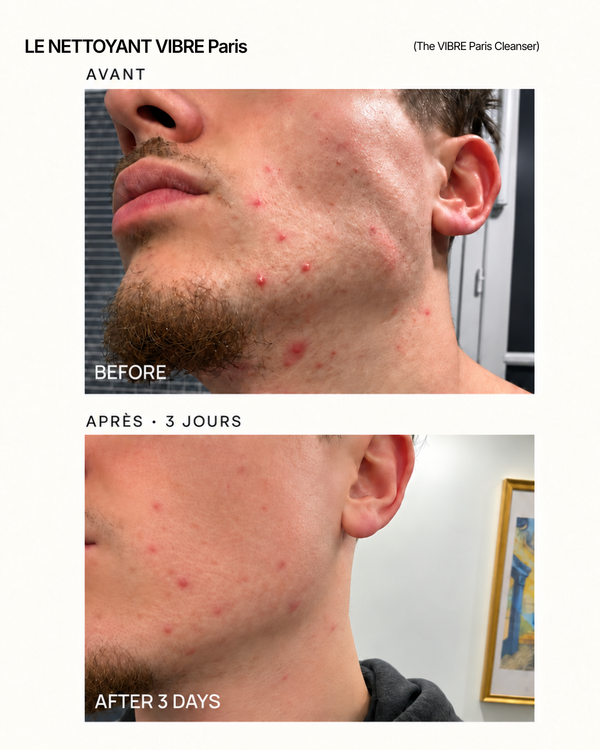
First, a cleanser that doesn’t strip away what your skin needs to retain. The Gentle Cleansing Gel removes sebum and daily impurities without stripping the skin: after rinsing, the skin remains supple and its natural lipids are preserved.
Next, support the production of this cement. Niacinamide is one of the best-documented active ingredients in this regard: in a study published in 2000 in the British Journal of Dermatology, it was found to increase the synthesis of ceramides and other lipids by epidermal cells, and its application reduced water loss in dry skin. It is the key active ingredient in the Regenerating Serum, which is applied immediately after cleansing, while the skin is still slightly damp.

Regenerating Serum — VIBRE PARIS
Finally, keep the water where it works best. The Plumping Cream contains multi-ceramides—similar to the lipids the skin produces on its own—and peptides that promote firmness. It limits evaporation and provides the skin’s surface with the environment its enzymes need.

Plumping Cream — VIBRE PARIS
Patience is key. Since a complete cycle of the stratum corneum takes several weeks, a skincare routine should be evaluated over several weeks, not just a few days—that’s the whole point of our article on the skin’s response time. Three steps, repeated morning and night: cleanse without stripping, treat, and protect the skin barrier. That’s the principle behind The Routine.
The skin can renew itself on its own. What we can offer it isn't speed—it's the right conditions.
Sources
- Grove GL, Kligman AM. “Age-associated changes in human epidermal cell renewal.” Journal of Gerontology, 1983 — PubMed
- Rawlings AV, Harding CR. “Moisturization and skin barrier function.” Dermatologic Therapy, 2004 — PubMed
- Tanno O, Ota Y, Kitamura N et al. “Nicotinamide increases the biosynthesis of ceramides and other stratum corneum lipids to improve the epidermal permeability barrier.” British Journal of Dermatology, 2000 — PubMed
- American Academy of Dermatology — “How to Safely Exfoliate at Home” (aad.org)