Changing Your Skincare Routine Every Month: Why Your Skin Hasn't Had Time to Adjust
Four weeks: that’s often how long we give a new serum before moving on to the next one. This intuition seems reasonable—if nothing has changed in a month, the product isn’t working. But the skin doesn’t follow our shopping schedule. It operates on a biological rhythm—that of skin renewal—which slows down over the years, and most of the effects we expect from a skincare product unfold over several of these cycles, not just one.
The Skin's Natural Rhythm
The epidermis is constantly renewing itself: cells are born in the basal layer, migrate toward the surface while undergoing transformation, and then shed one by one. Measurements taken on healthy volunteers have shown that simply passing through the stratum corneum takes about 20 days in young adults and more than 10 additional days in older adults. The number of layers, however, does not change: it is the production of new cells that slows down, and this slowdown appears to accelerate after age 50.
In practical terms, the skin we see in the mirror this morning was formed several weeks ago. A skincare product applied tonight first acts on cells that won’t surface until much later.
What a month allows us to judge—and what it does not
Some things can be assessed in just a few days: how comfortable the skin feels after cleansing, whether it feels tight, and whether the texture is right for you. Others require much more patience. Skin texture, radiance, and an even complexion depend on these successive cycles. Clinical trials reflect this as well: one of the landmark studies on niacinamide applied to the face followed its participants for twelve weeks, with evaluations every four weeks—precisely because a single cycle isn’t enough to measure a change in texture.
The same principle applies to the skin barrier. After damage, young skin regains most of its function within a few days; older skin takes longer. The repair time increases as cell turnover slows down.
The skin doesn't read labels. It responds to consistency, cycle after cycle.
The Cost of Constant Change
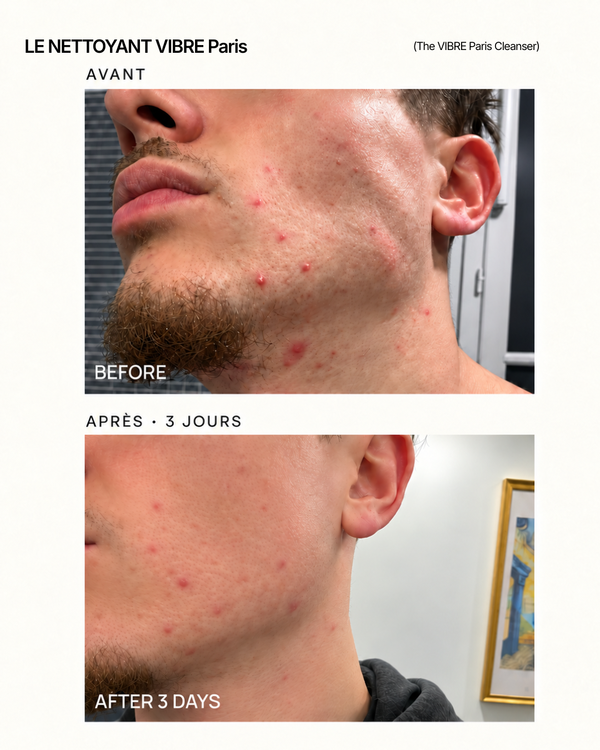
Every new product forces the skin to adapt all over again: a new base, different preservatives, sometimes a fragrance, sometimes an unfamiliar active ingredient. Introducing these new products one after another increases the chances of irritation without ever giving a skincare product time to show what it can do. The American Academy of Dermatology emphasizes this point regarding acne: switching from one product to another every few days can irritate the skin and lead to new breakouts, whereas a suitable treatment should be evaluated over four to six weeks, and a noticeable improvement often takes two to three months.
The result is all too familiar: a shelf that keeps filling up, skin that never quite calms down, and the feeling that nothing works. We talked about this in that article on skincare products we never use—and the benefits of stopping the hoarding.
Give a thoughtful gesture time to take effect
So the right question isn't "Is it working yet?", but "Is my skin tolerating it well?". If the answer is yes, time will take care of the rest. Obvious discomfort—a burning sensation, persistent redness, or itching—is not part of the adjustment period: it’s a sign that you should stop using the product and seek advice.
It is with this in mind that VIBRE PARIS’s Regenerating Serum was developed: to deliver lasting results rather than immediate ones. Niacinamide, a well-tolerated active ingredient, improves skin texture, pore appearance, and radiance over the course of several weeks, in a formula designed to be applied morning and night, without a second thought.

Regenerating Serum — VIBRE PARIS
And because a serum alone doesn’t make a routine: cleanse without stripping the skin, treat, and protect the skin barrier. Three steps, the same ones every day, so that the skin finally has a stable foundation on which to respond. That’s what La Routine brings together.

The Routine — VIBRE PARIS
How to Evaluate a Treatment Objectively
A photo on the first day, in front of the same window at the same time. Another one after six weeks, then after three months. We compare how the light falls on the skin, not our morning mood. And we change only one thing at a time: that’s the only way to know what really made a difference.
Sources
- Grove GL, Kligman AM. “Age-associated changes in human epidermal cell renewal.” Journal of Gerontology, 1983 — PubMed
- Bissett DL, Oblong JE, Berge CA. “Niacinamide: A B vitamin that improves the appearance of aging facial skin.” Dermatologic Surgery, 2005 — PubMed
- American Academy of Dermatology — “9 Things to Try When Acne Won’t Clear Up” (aad.org)
- “Aging Skin Barrier,” Journal of Cosmetic Science, vol. 75, no. 5 — Barrier Recovery and Stratum Corneum Renewal According to Age (library.scconline.org)