Urban Pollution: What It Really Does to Your Face
We tend to think that pollution merely “dirty” the skin—a layer of gray dust that a quick rinse with water would be enough to wash away. But that underestimates what settles on your face after a day in the city. The finest particles and gases like ozone or nitrogen dioxide don’t just sit on the surface: when they come into contact with the skin, they trigger reactions that slowly wear it down. The good news is that the solution doesn’t involve yet another “anti-pollution” cream or a complicated skincare routine. It comes down mainly to how you cleanse in the evening and the condition of your skin barrier.
What the city air leaves on your skin
Urban pollution is a mixture of various components. First, there are particulates, largely from traffic: soot and fine dust, most of which is smaller than 2.5 micrometers in diameter. Then there are the gases, foremost among them ozone—which forms in the summer under the sun’s rays—and nitrogen dioxide, which is produced by engines. As journals dedicated to the subject point out, the skin, along with the lungs, is one of the very first organs to come into contact with this air.
Its first line of defense is the stratum corneum, that thin layer made up of cells and lipids that form a protective barrier. It is this layer that, day after day, absorbs what we breathe in without even thinking about it.
What the research has shown
For a long time, “extrinsic” skin aging—that is, aging caused by environmental factors—was attributed almost entirely to sun exposure, and later to smoking. In 2010, a German study published in the *Journal of Investigative Dermatology* identified a third factor. By tracking 400 elderly women living either in the industrial Ruhr region or in a rural area, the researchers observed that exposure to traffic-related particulate matter was associated with more signs of skin aging—primarily age spots on the forehead and cheeks, and to a lesser extent, deeper wrinkles.
This is an observational study: it shows an association, not proof on its own. However, other cohort studies in Europe and Asia have reached similar conclusions, and laboratory research has proposed consistent mechanisms. Among residents of large, heavily polluted cities, some clinical studies have also found higher sebum production and more reactive skin.
The city doesn't leave its mark on you in a single day. It wears you down a little, every day, if you let it.
The mechanism: oxidative stress that originates at the surface
The common thread linking these observations is oxidative stress. When pollutants come into contact with the skin, they generate unstable molecules that damage the lipids in the stratum corneum and deplete its natural antioxidant defenses. Ozone, in particular, does not penetrate deeply: it first acts on the surface, and then the reaction spreads to deeper layers. Certain particles also carry compounds that activate a cellular receptor involved in pigment production, which explains the link to dark spots.
A skin barrier that’s already weakened—by harsh cleansers, cold weather, or heating—offers less resistance. That’s why experts studying these issues emphasize not so much a “miracle” ingredient as two simple habits: removing buildup and supporting the barrier.
The evening routine—the one that matters most
When you return from a day in the city, your face is covered with a film made up of a mixture of sebum, sweat, cream residue, and particles. Your evening cleansing routine is meant to remove this film, not to strip your skin: a cleanser that’s too harsh would do exactly what you’re trying to avoid by weakening the lipid barrier. If you wear sunscreen or makeup, our article on double cleansing will help you determine when a second cleanse is necessary.
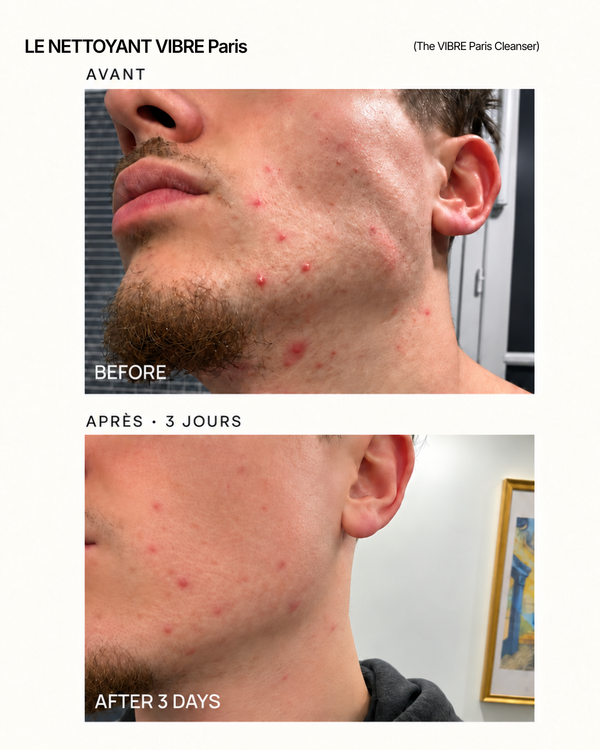
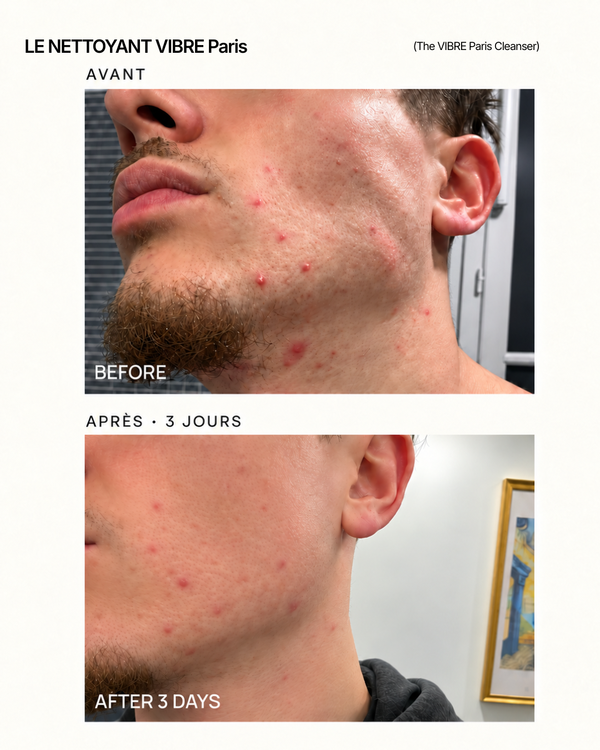
That’s what VIBRE PARIS’s Gentle Cleansing Gel is designed to do: remove the day’s residue without stripping away the skin’s protective oils. A small amount, lukewarm water, a gentle massage with your fingertips, a thorough rinse, and pat-drying.

Gentle Cleansing Gel — VIBRE PARIS
Next comes the ingredient that strengthens the skin barrier itself. The Plumping Cream combines multi-ceramides—which are similar to the lipids produced by the skin—with peptides: it doesn’t claim to form a shield against city air, but rather helps the skin maintain a strong foundation to withstand it.

Plumping Cream — VIBRE PARIS
Needless to say
When it comes to pollution, it’s tempting to layer on products: a mist, a specialized serum, and a detox mask. Research doesn’t support this layering. What it does support is gentle, regular cleansing, maintaining a healthy skin barrier, and applying sunscreen in the morning—especially since particulate matter and UV rays appear to have a combined effect on pigmentation. Our article on daily sun protection goes into more detail about this last step.
The rest comes down to three steps, repeated morning and night: cleanse, treat, and protect the skin barrier. That’s the whole concept behind La Routine —Gentle Cleansing Gel, Regenerating Serum, and Plumping Cream.

The Routine — VIBRE PARIS
We don't always get to choose the air we breathe. We do, however, get to choose what we do every night when we get home.
Sources
- Vierkötter A, Schikowski T, Ranft U, Sugiri D, Matsui M, Krämer U, Krutmann J. “Airborne particle exposure and extrinsic skin aging.” Journal of Investigative Dermatology, 2010 — PubMed
- Krutmann J et al. “Pollution and skin: from epidemiological and mechanistic studies to clinical implications.” Journal of Dermatological Science, 2014 — PubMed
- Fussell JC, Kelly FJ. “Oxidative contribution of air pollution to extrinsic skin aging.” Free Radical Biology and Medicine, 2020 — PubMed Central
- Krutmann J et al. “Pollution and Acne: Is There a Link?” *Clinical, Cosmetic and Investigational Dermatology*, 2017 — DOI