Sugar and Skin Aging: What Glycation Really Does
We often hear that sugar “makes the skin age,” and it’s easy to imagine that one too many desserts would show up on your face the next day. The idea isn’t wrong, but it’s off in terms of the time scale. The phenomenon in question—glycation—is real and well-documented by research; however, it takes years to take effect, not just a single meal. And when it comes to facial skin, what keeps it healthy on a daily basis isn’t found solely on your plate.
What is known as glycation
Glycation is a spontaneous chemical reaction: a sugar, such as glucose, binds to a protein without the assistance of any enzymes. It should not be confused with glycosylation, a controlled enzymatic process that the body needs to function. Glycation, on the other hand, occurs randomly wherever sugars and proteins come into contact.
At first, this bond is reversible. Over time, however, some of it rearranges into stable compounds, which researchers call advanced glycation end products. This is the same type of reaction that causes the crust of bread to brown in the oven: the Maillard reaction. In the body, it simply occurs much more slowly.

The Routine — VIBRE PARIS
Why Collagen Takes Center Stage
The collagen in the dermis forms the skin’s structural framework: a network of fibers that gives it its firmness and strength. What sets it apart is how slowly it renews itself. In 2000, a Dutch research team estimated the turnover time of skin collagen by measuring a marker of protein age: it would take about 15 years for half of this collagen to be replaced. In the same study, the amount of glycation products attached to this collagen increased steadily with age. A protein that remains in place for a long time has plenty of time to accumulate these marks.
The problem isn’t so much the presence of sugar as what it ultimately causes. In an article published in 2010 in *Clinics in Dermatology*, William Danby describes the core mechanism: glycation can permanently bind two collagen fibers together, and fibers that are fused in this way do not repair well. The network becomes stiffer, less flexible, and less able to remodel itself. This is one of the factors that explains the loss of firmness observed over the years, alongside sun exposure and the natural slowing of the dermis, which we detail in our article on loss of firmness.
The skin doesn't bear the marks of a single night out. It bears the marks of what repeats itself, day after day, for years on end.
Sugar on the Plate: A Real Role, But One That Needs to Be Put into Perspective
Glycation accelerates in all tissues when blood sugar levels remain high. In fact, it was first studied in people with diabetes. Even without blood sugar issues, the body constantly regulates its sugar levels: a single dessert doesn’t show on your face—nor does a week of holiday feasting.
A review published in 2013 in the same journal candidly points out that the role of diet in skin aging remains highly debated, and solid evidence is still limited. Eating a varied diet and avoiding excessive added sugars remains a good guideline for overall health. But no diet can stop the skin from aging, and treating every piece of cake as a sin doesn’t help any more than that.
What Contributes to Glycation on the Face: Light
The same article by William Danby highlights a point that is often overlooked: in the skin, ultraviolet rays also stimulate the formation of these bonds between collagen fibers. Since the face is exposed year-round, this issue extends far beyond the summer months. A review published in 2012 in *Dermato-Endocrinology* also lists these glycation products among the markers found in sun-damaged skin areas.
That’s where a simple, practical step comes in—one that’s nothing spectacular: applying sunscreen every morning in sufficient amounts and reapplying it during prolonged exposure. Our article on daily sun protection explains why this step is just as important in November.
What a Routine Can Do—and What It Can't
Let's be clear: no cosmetic treatment can undo the bonds that have already formed in the dermis. What a skincare routine can do is help maintain skin that feels firm, supple, and comfortable on the surface, day after day. That's often what you notice in your daily life.
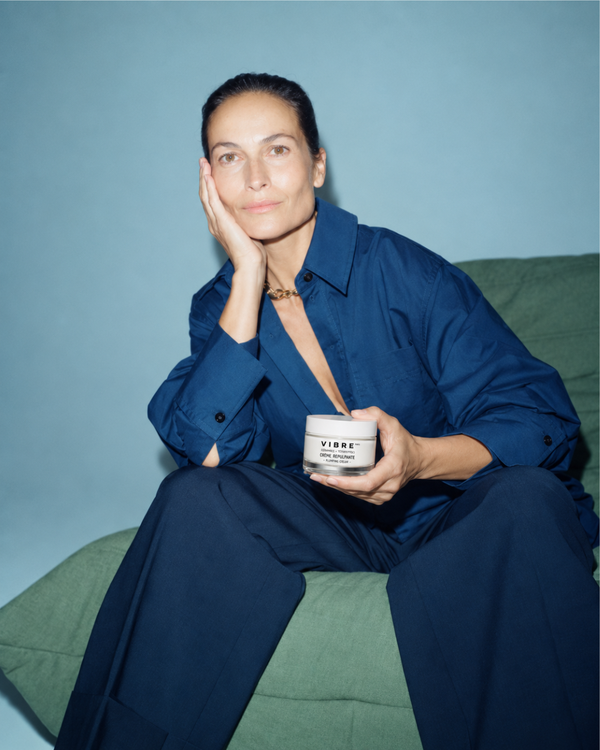
In the evening, the Gentle Cleansing Gel removes sunscreen and the day’s buildup without stripping the skin. Next comes the Regenerating Serum, whose niacinamide helps improve skin texture and radiance. Finally, the Plumping Cream combines multi-ceramides—similar to the lipids the skin produces naturally—with peptides that help maintain firmness. It protects the skin barrier and keeps the skin’s surface supple, which is especially important for skin that’s losing some of its firmness.

Plumping Cream — VIBRE PARIS
Three steps, the same every morning and evening: cleanse without stripping the skin, treat, and protect the skin barrier. That’s the whole idea behind La Routine. In the morning, simply add sunscreen.
Sugar isn't an enemy you need to hunt down at every meal. What matters—for your skin as well as everything else—is what you do without even thinking about it, every day.
Sources
- Danby FW. “Nutrition and Aging Skin: Sugar and Glycation.” *Clinics in Dermatology*, 2010 — PubMed
- Verzijl N, DeGroot J, Thorpe SR et al. “Effect of collagen turnover on the accumulation of advanced glycation end products.” Journal of Biological Chemistry, 2000 — PubMed
- Gkogkolou P, Böhm M. “Advanced glycation end products: Key players in skin aging?” Dermato-Endocrinology, 2012 — PubMed Central
- “Aging Skin: The Role of Diet: Facts and Controversies.” Clinics in Dermatology, 2013 — PubMed