Shaving Rash: Why Your Skin Gets Irritated After Shaving, and How to Soothe It
After shaving, the skin feels hot, turns red, and stings when it comes into contact with aftershave: this is known as “razor burn,” and it’s often attributed to overly sensitive skin or a poor-quality razor blade. The cause is more mechanical than that. Each pass of the razor blade rubs against the skin’s surface as it cuts the hair, and this repeated friction breaks down the skin’s protective barrier. The good news is that most of this can be addressed by adjusting your technique before, during, and after shaving.
Shaving rash or ingrown hair: two different reactions
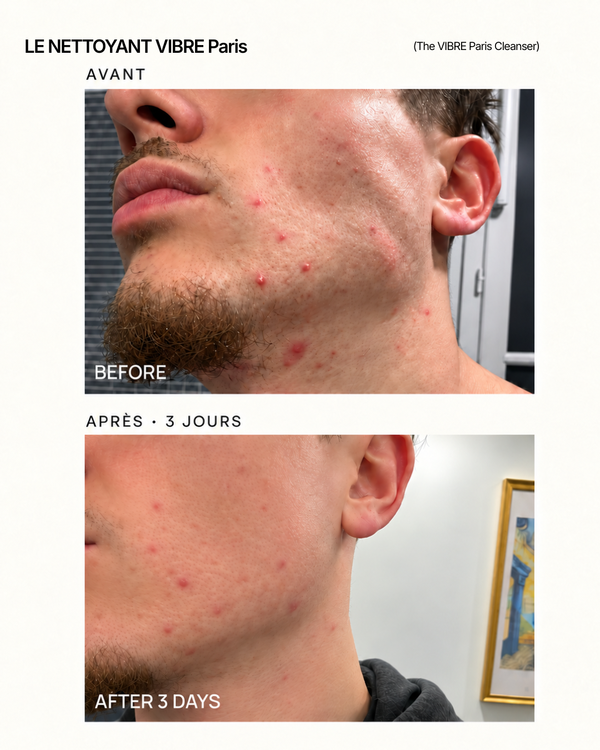
Razor burn appears within minutes of shaving: a burning sensation, tingling, itching, and diffuse redness. It results from superficial irritation caused by the blade’s micro-friction against the skin and around the follicle openings. The small red bumps that appear one or two days later are caused by a different mechanism: pseudofolliculitis barbae. When cut at an angle, the hair regrows with a sharp tip that can curl back and penetrate the skin again; the body then reacts as it would to a foreign body, causing local inflammation. Very curly and thick hairs are particularly prone to this condition.
A Close Shave: A Misconception
Shaving against the grain, stretching the skin with your fingertips, and going over the same area several times: these habits make your skin feel smoother in the moment. But shaving very closely is actually one of the factors that promote ingrown hairs. Advice from the American Academy of Dermatology and DermNet is consistent: shave in the direction of hair growth, using short strokes, without stretching the skin or applying excessive pressure. The result may seem slightly less clean on the first day, but your skin will remain calmer in the days that follow.
A successful shave isn't judged by how perfectly smooth your skin is in the morning, but by how calm it feels the next day.
Prepare the hair rather than forcing the blade
Beard hair is significantly more resistant to cutting than the hair on your head. Water changes everything: as it absorbs moisture, it softens, and the force needed to cut it decreases significantly, with most of the effect achieved within a few minutes of contact. That’s why it’s best to shave at the end of your shower, or after placing a warm, damp towel on your face for a few moments. A gentle cleanse just before shaving removes the sebum and dead skin cells that keep the hair flat, helping it stand upright. VIBRE PARIS’s Gentle Cleansing Gel fulfills this role without stripping the skin: it cleanses the skin, yes, but it doesn’t strip it of oils to the point of weakening it before the razor even makes its first pass.

Gentle Cleansing Gel — VIBRE PARIS
Next comes lubrication: a moisturizing shaving foam or gel reduces friction against the blade. Without it, the blade catches on the skin just as much as it does on the hair. A dull blade has the same effect: the American Academy of Dermatology recommends replacing a disposable razor every five to seven uses and letting it dry between shaves.
After Shaving: Repair Rather Than Disinfect
A lotion that stings badly isn’t a sign that it’s working—it’s mainly a sign that the skin is already irritated. After rinsing with lukewarm water and applying a cool, damp towel for a few moments, the priority is to restore to the skin what shaving has stripped away. Humectants like glycerin draw water into the stratum corneum, while emollients soften the skin’s surface. Niacinamide, meanwhile, has been the subject of specific studies in men: when applied as a moisturizer, it improved the barrier function of the skin on the neck, an area particularly stressed by shaving. In particular, it is thought to support the synthesis of ceramides, the lipids that ensure the cohesion of the stratum corneum.
This is the logic behind the Regenerating Serum, formulated with niacinamide, followed by the Firming Cream and its multi-ceramides, which help strengthen the skin’s barrier. Applied after shaving, to skin that has been rinsed and patted dry, they can be used in place of an alcohol-based aftershave.

Regenerating Serum — VIBRE PARIS
When the Skin Bears Scars
On medium to dark skin tones, each episode of inflammation can leave a brown spot that persists long after the pimple has disappeared: this is post-inflammatory hyperpigmentation, the mechanisms of which are detailed in our article on brown spots and how to properly identify them. This is yet another reason never to remove an ingrown hair with tweezers or a needle. If the bumps keep coming back despite taking the right precautions, become infected, or leave raised scars, you should see a dermatologist: other solutions are available, ranging from changing your hair removal method to specialized treatments. To learn more about daily men’s skincare, our article on what a men’s skincare routine should really include complements these guidelines.
Gently cleanse before, support the skin barrier afterward: shaving then becomes part of a three-step routine rather than a series of products designed to repair its effects.

The Routine — VIBRE PARIS
Sources:
- American Academy of Dermatology — Preventing Razor Bumps: Tips from Dermatologists
- DermNet — Pseudofolliculitis barbae
- Draelos Z.D., “Male Skin and Ingredients Relevant to Male Skin Care,” British Journal of Dermatology, 2012, 166 (Suppl. 1) — doi:10.1111/j.1365-2133.2011.10784.x